


Home
IPO
Invest in IPOs
Get Early Access to India's Fastest-Growing Companies
Participate in upcoming IPOs and become a shareholder from day one

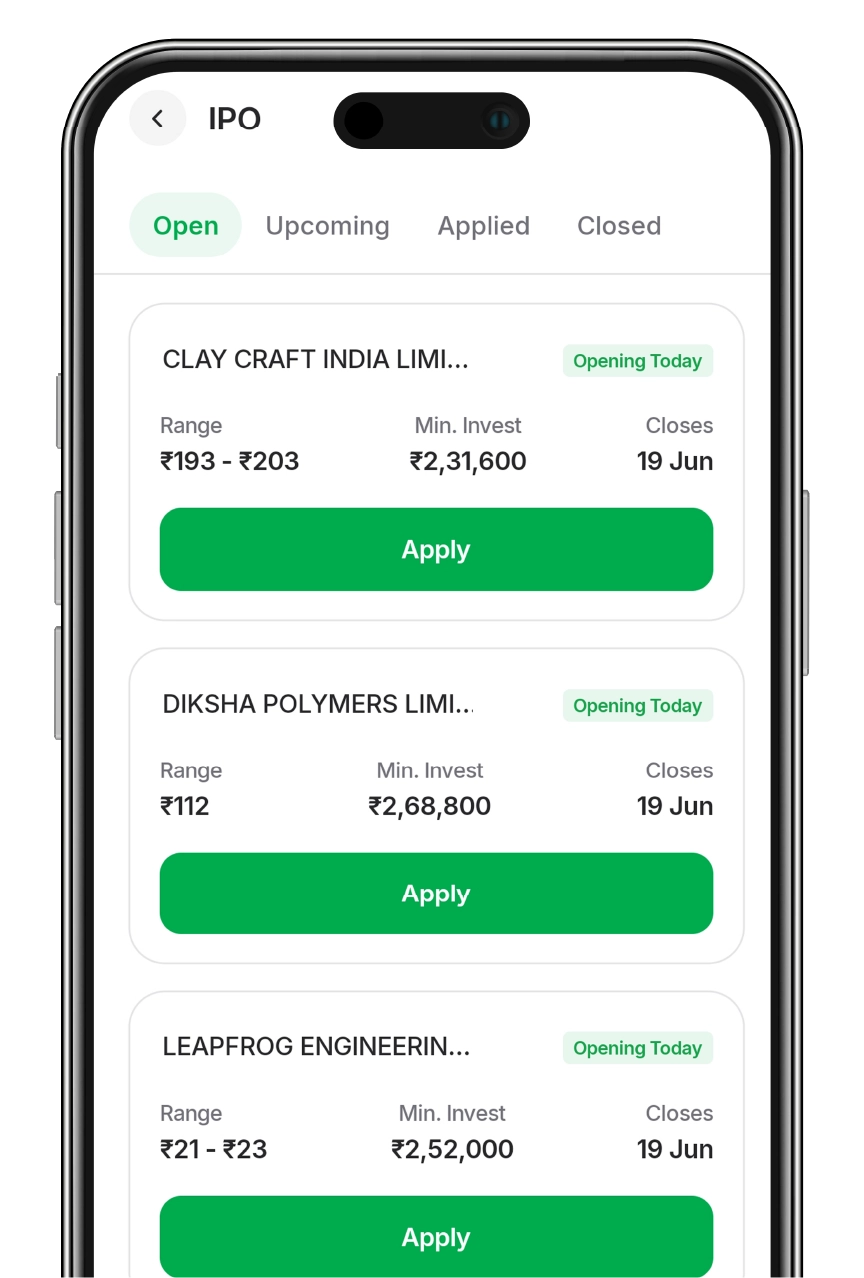

IPO List
What are IPOs?
An Initial Public Offering (IPO) is when a privately held company offers shares to the public for the first time, becoming a listed company. This allows businesses to raise capital and provides investors with ownership opportunities.
Why do companies go public?

Raise funds for expansion

Boost credibility and brand recognition

Provide exit routes for early investors/founders

Reduce debt burden
Who Can Invest
in IPOs?
Any individual investor, institutional investor, high-net-worth individual (HNI), or qualified institutional buyer (QIB) meeting the IPO eligibility criteria can apply for an IPO.
Retail investors need a demat account and PAN card, while companies must meet SEBI regulations. Foreign investors can participate via foreign institutional investor (FII) routes.

Retail Individual Investors (RII)

High Net-worth Individuals (HNI)

Qualified Institutional Buyers (QIB)

Anchor Investors

Company Employees
| Category | Who it is | Application size | Reserved share |
|---|---|---|---|
| Retail Individual Investor (RII) | Resident individuals and NRIs applying in their own name | Up to ₹2,00,000 per PAN | Min 35% |
| Non-Institutional Investor (NII / HNI) | Individuals, HUFs, trusts and companies applying above the retail limit | Above ₹2,00,000, no cap | Min 15% |
| Qualified Institutional Buyer (QIB) | Mutual funds, insurers, banks, pension funds and registered foreign investors | No fixed limit | Max 50% |
| Anchor Investor | A QIB that commits before the issue opens, at a price set separately | Minimum ₹10 crore | Carved out of the QIB portion |
| Company Employees | Employees of the issuing company, where an employee quota is offered | As set in the offer document, often at a discount | As disclosed per issue |
The 35 / 15 / 50 split applies to issues that meet SEBI's profitability norms. Where a company does not meet them, the split changes — the retail share falls and the institutional share rises. The NII portion is itself divided between applications of ₹2–10 lakh and those above ₹10 lakh. The exact reservation for any issue is stated in its offer document.
Why Invest in IPOs?
Explore how IPOs open doors to opportunities, strengthen your portfolio, and create potential for wealth.
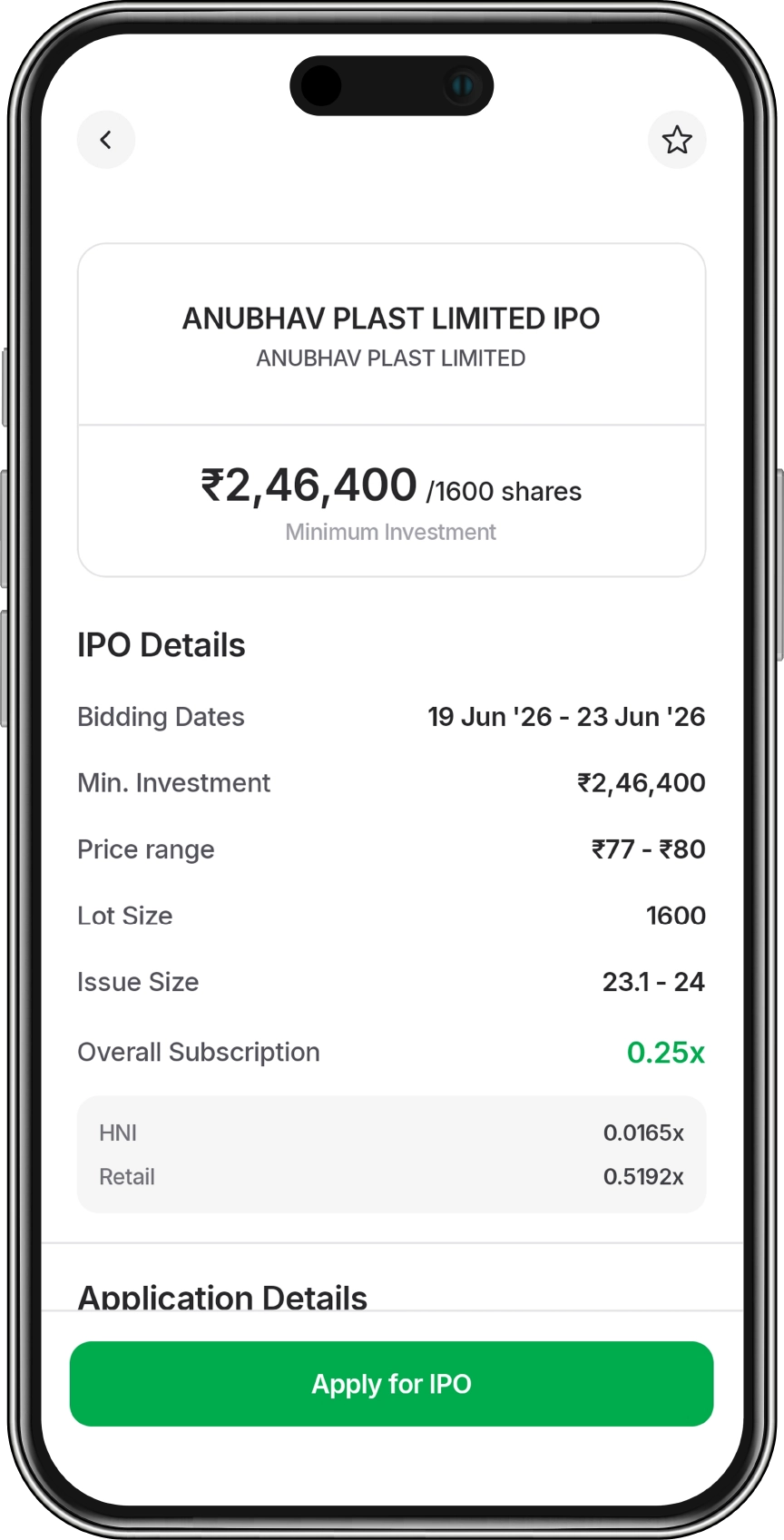
Categories of IPOs
The different routes businesses take when they decide to go public with investors.

Fixed Price IPO
Shares issued at a pre-set price

Book Building IPO
Price discovered via investor bids within a range

SME IPO
Designed for small & medium enterprises raising capital

How to Apply for an IPO
Log in to your Indiabulls securities limited Trading Account
Navigate to the IPO Section
View Upcoming IPOs
Select Lot Size & apply using UPI
Track Allotment Status in your dashboard
IPO Glossary
The twelve terms you will meet most often in an offer document or on an application screen, in alphabetical order.
Anchor investor
A large institutional investor that commits to the issue a day before it opens, at a price set separately from the main book.
ASBA (Application Supported by Blocked Amount)
The mechanism by which your application money is blocked in your bank account rather than debited, and released if you don't receive an allotment.
Basis of allotment
The document published by the registrar after an issue closes, showing how shares were allocated in each category — including the lottery ratio for retail applicants.
Book building
A price-discovery method in which investors bid within a published band and the final issue price is set from the demand received.
Cut-off price
A bidding option available to retail applicants: you accept whichever final price is discovered, which keeps your application valid across the whole band.
Grey Market Premium (GMP)
An unofficial price quoted for IPO shares before they list, in an unregulated market outside the stock exchanges. It is not a forecast of the listing price, cannot be independently verified, and carries no regulatory protection.
Lot
The fixed number of shares that make up one application unit. Applications are made in whole lots only.
Offer for Sale (OFS)
The part of an issue in which existing shareholders sell their shares. This money goes to those shareholders, not to the company.
Oversubscription
When applications received exceed the shares on offer, expressed as a multiple — for example, 4x. It determines whether allotment goes to a lottery.
Price band
The lower and upper price limits within which investors may bid in a book-built issue.
Red Herring Prospectus (RHP)
The final offer document filed before an issue opens, containing the price band, dates, risk factors and the intended use of proceeds. The earlier draft version is the DRHP, which carries no price or dates.
UPI mandate
The approval request your bank sends to your UPI app to block the application amount. An unapproved mandate means you have no valid application.
Blogs
Articles that simplify trading strategies for smarter, more confident trades

What is an Offer For Sale (OFS)?
Understand what an Offer For Sale (OFS) is, how it works, who can participate, and the key factors investors should consider before investing.
Read More
What Is an IPO Prospectus and How to Read and Analyse It?
When a company decides to go public, it must share a detailed document with potential investors befo...
Read More
Post-IPO Performance: What to Look for & How to Trade after Listing
When a company first lists on the stock exchange, excitement often runs high. Many investors track p...
Read More
IPO vs FPO Which Should New Investors Choose First Indiabulls Securities
When someone starts exploring the equity market, a term that often appears right away is IPO vs. FPO...
Read More
How to Check IPO Allotment Status Online?
Applying for an IPO is always exciting. You've done your research, invested your money, and now come...
Read More
HD Fire Protect IPO: Five Things in the Prospectus That the IPO Pages Leave Out
The company paid ₹140.18 crore in dividends in a year it earned ₹116.79 crore. That and four other disclosures sit in the prospectus, and nowhere else.
Read More
Frequently Asked Questions
Allotment, minimum amounts, cut-off bidding and what happens to your money answered.
When an issue is oversubscribed, retail applications go into a computerised lottery run by the registrar, designed to give at least one lot to as many applicants as possible. Once an issue is heavily oversubscribed, applying for more lots does not improve your chances in the retail category. The registrar publishes the basis of allotment after the issue closes.
Risks in IPO Investments

Market Volatility
Prices may fluctuate post-listing

Overvaluation
Hype-driven pricing may not sustain

Limited Data
New companies may lack historical performance records

Allotment Uncertainty
Oversubscription reduces chances of share allocation
Expert Guidance for Confident Investments
Need support with your investments? Our Assisted Brokerage Model pairs you with a Relationship Manager for personalized guidance

Expert Advice
Access to market updates and insights.

Dedicated Support
Guidance aligned to your investment goals.

In-Depth Research
Access comprehensive fund analysis and market reports.